LXXXI–XC
CONVERSA XC | Arquivo 237 | 03–12–2014
Arquivo de Destruição
Arquivo de Destruição
Archive of Destruction
O “Arquivo de Destruição” é uma estrutura sem morada fixa dedicada à recolha de documentos referentes a ações e ideias que representam uma negação da sua função básica, a preservação da memória, e que se estendem às mais diversas áreas — dentro de parâmetros bem definidos — onde ideias de destruição, tanto física como abstrata, podem ser encontradas.
The archive of destruction is a nomadic structure dedicated to gathering documents on actions and ideas that represent the denial of its primary function, the preservation of memory, and that extend to the most diverse areas — within well-defined parameters — where ideas of destruction, both physical and abstract, can be found.
Conversa
Em paralelo com a apresentação de registos documentais de algumas manifestações do “Arquivo de Destruição” teve lugar uma breve descrição dos seus parâmetros de funcionamento, que serviu de base para uma abordagem a algumas questões inerentes ao caráter do arquivo, como p. ex., relações entre memória e destruição, o seu carácter de recusa fundamental, ou o seu potencial como ferramenta crítica.
Parallel to the presentation of documentary records of a few manifestations of “Arquivo de Destruição” (archive of destruction) there was a brief description of its operating parameters, which functioned as the basis for an approach to some issues related to the archive character, such as the relations between memory and destruction, its fundamental character of refusal, or its potential as a critical tool.
João Fiadeiro / ATELIER | RE.AL
Composição em Tempo Real
Real Time Composition
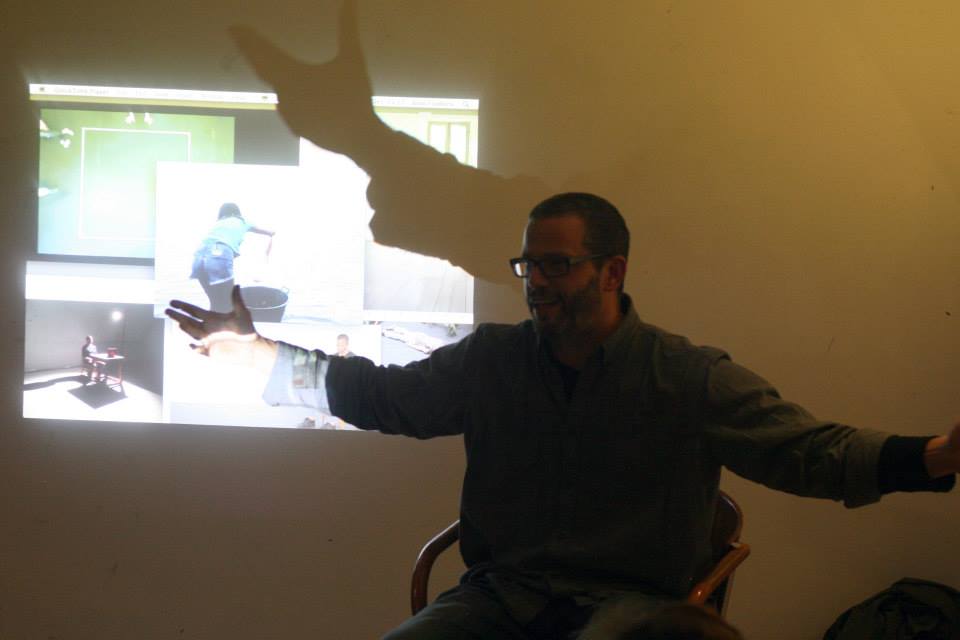
João Fiadeiro (1965) pertence à geração de coreógrafos que emergiu no final da década de oitenta em Portugal e que deu origem à Nova Dança Portuguesa. É diretor artístico do ATELIER | RE.AL (fundado em 1990) que, para além da criação e difusão dos seus espetáculos - apresentados regularmente por toda Europa, América do Norte e do Sul – desenvolve uma programação de residências artísticas e apresentações de projetos transdisciplinares. Toda a sua atividade gravita em torno da prática, da investigação e da aplicação do método de Composição em Tempo Real (CTR), um sistema composição e improvisação desenvolvido desde 1995, sendo atualmente estudado, desenvolvido e utilizado por diversos artistas e investigadores.
Joao Fiadeiro (1965) is part of the generation of choreographers that emerged in the late eighties in Portugal and that gave rise to the New Portuguese Dance (Nova Dança Portuguesa). He is the artistic director of ATELIER | RE.AL (founded in 1990) which, in addition to creating and disseminating his shows - regularly presented throughout Europe, North and South America - develops a program of artistic residencies and performances of transdisciplinary projects.
His entire activity revolves around the practice, research and application of the Composition in Real-Time method (CTR – Composição em Tempo Real), a composition and improvisation system developed since 1995, currently studied, developed and used by various artists and researchers.
Conversa
Da perspetiva da Composição em Tempo Real, o gesto criativo não pode resultar de uma intenção ou projeção pessoal. Tem que ser a consequência de um encontro. Um encontro com um tempo, um espaço, um outro, uma coisa, um afeto... A força desse encontro, a sua importância e influência, é diretamente proporcional à capacidade que este tem para suspender a nossa trajetória, por milésimos de segundos que sejam, e gerar a dúvida, o espanto.
From the perspective of Composição em Tempo Real (composition in real time), the creative act cannot result from an intention or personal projection. It has to be the result of an encounter. An encounter with a time, a place, another being, a thing, an affection… The strength of this meeting, its importance and influence, is directly proportional to its capacity to suspend our path, by milliseconds, and generate doubt, or wonder.
Luís Lopes
Paradoxo, Não-Linearidade
Paradox, Nonlinearity
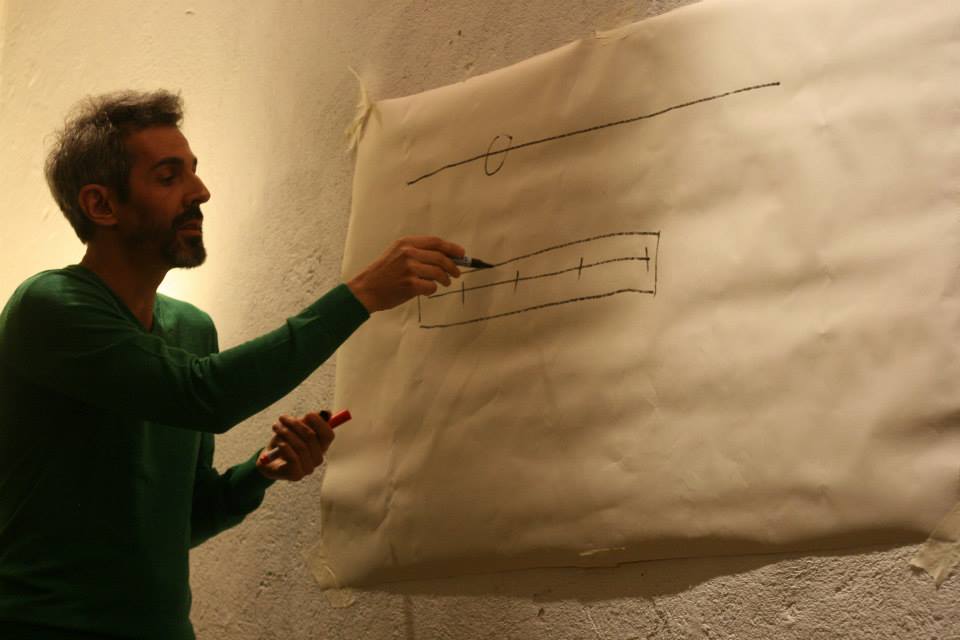
Avesso a qualquer linearidade, o idiossincrático Luís Lopes, músico ligado à(s) musica(s) dita(s) de improvisada(s) e experimental, constrói a sua carreira, uma simples história, livre de espartilhos, amarras formais e malabarismos técnicos a tender para o absolutamente inócuo. É um não seguidista… Experimenta-se paradoxalmente. Invoca ensinamentos seguindo padrões de subversão de qualquer possibilidade de ideia pré-instituída. Auto-subversão eminente…Transe introspetivo atemporal.
Averse to any linearity, the idiosyncratic Luís Lopes, a musician linked to the so called improvised and experimental music(s), builds his career, a simple story, free of corsets, formal ties and technical juggling, tending to the absolutely innocuous. He is an unfollower... Self experiments through paradoxes. Invokes teachings by subverting the standards of any possibility of a pre-established idea. Eminent self-subversion ... Introspective and timeless trance.
Conversa
Luís Lopes, músico ligado à música improvisada e experimental, com link ao jazz, apresentou a sua conversa sob o nome de PARADOXO, NÃO-LINEARIDADE! Para isso, direcionou a Conversa para dois pontos imprescindíveis para a compreensão, ou tentativa de compreender o que significa a possível ação de improvisar, no seu caso, com um instrumento. Por um lado a tomada de consciência da interação performer-público-espaço, que na melhor das hipóteses forma um triângulo equilátero perfeito, atitude realista de condição, atemporal. E por outro lado, através de dois esquemas/desenhos muito simples, captar a atenção, não só, para o fator subversivo de caminho individualista anti ideia pré-instituída perante hipóteses de solução de continuidade entre estratégia, intuição e decisão, e depois também para a problemática do tempo, ou tentativa de subversão do mesmo através de técnicas de arrastamento, que apontam para o esbatimento ou mesmo eliminação possível da aparente sequência presente-passado-futuro.
Luís Lopes. musician tied to improvised and experimental music, with links to jazz, presented his conversation under the title PARADOX, NON-LINEARITY! For that, he steered the conversation to two essential points for understanding, or trying to understand, the possible action of improvising, in his case with an instrument. On the one hand, the awareness of the performer-audience-space interaction, which at best forms a perfect equilateral triangle, realistic attitude condition, timeless. And on the other hand, through two very simple schemes/drawings, capturing the attention not only to the subversive factor of the individualistic path against pre-established ideas before solution hypothesis of continuity between strategy, intuition and decision, and then also to the problem of time, or attempt to subvert it through dragging techniques, towards blurring or even possibly eliminating the apparent present-past-future sequence.